How the method works
How to make a pickle, in the order the steps actually happen
One page that walks the whole procedure once, so that every recipe on this site can be read as a variation on it rather than as a list.
On this page
On this page
- Choosing the vegetable and the family of pickle it belongs to
- Preparing the vegetable, including the one cut that is published
- Making the brine or the salt mixture
- Filling the container and setting the weight
- Holding the temperature, which sets the clock
- Watching the surface and deciding it is finished
- Storing in place or canning in jars
Every fermented vegetable on this site follows the same sequence of gestures. This page walks that sequence once, in the order the steps actually happen, and at each step names the one number that is not negotiable and the reason it exists. The published recipes behind it are for cucumbers and for cabbage; where a number exists only for one of those, the page says so, and where nothing has been published, the page says that too.
Choosing the vegetable and the family of pickle it belongs to
The national guide sorts pickled products into four families: "Fermented or brined pickles," "Fresh-pack or quick-process pickles," "Fruit pickles," and "Relishes" (NCHFP-Pickle-Gen). Only the first family is this page's subject. Oregon State's PNW 355 states the technical difference plainly: in brined pickles, "acid is produced as lactic acid bacteria grow" over several weeks of curing, while in quick pickles "it is critical to add enough vinegar to prevent bacterial growth." So the first decision, before any salt is measured, is which family you are making. The numbers that follow are fermentation numbers.
Salt's role is published and consistent: "salt favors the growth of desirable bacteria while inhibiting the growth of others" (NCHFP-Ferment-Gen), and it "causes the cabbage cells to release fermentable sugars and inhibits growth of undesirable yeasts, molds, and bacteria. The bacteria needed for safe fermentation tolerate higher concentrations of salt" (CSU-Sauerkraut).
Preparing the vegetable, including the one cut that is published
For fermented cucumbers the instruction is exact: "Wash cucumbers. Cut 1/16-inch slice off blossom end and discard. Leave 1/4-inch of stem attached" (NCHFP-Dill; PNW 355). The blossom-end cut is the one preparation step the sources make compulsory; they do not publish the reason on the same page, so it is not speculated on here. For cabbage, the preparation is shredding, because the published salt ratios are given per weight of shredded cabbage (NCHFP-Kraut).
Making the brine or the salt mixture
Here the numbers differ by vegetable, and the sources do not convert between them. For cabbage, the ratio is 3 tablespoons of salt per 5 pounds of shredded cabbage (NCHFP-Kraut; PNW 355; Penn State; Clemson). Colorado State converts that ratio into the only published percentage, 2 to 2.5 percent salt by weight, and Penn State publishes a separate small-batch variant of 3 1/2 tablespoons of canning salt per 5 pounds of cabbage for jar fermentation (CSU-Sauerkraut; PSU-Ferment). Penn State's 3 1/2 tablespoons and the more common 3 tablespoons are both published for 5 pounds of cabbage; the two do not agree, and this page does not choose between them.
For fermented cucumbers, the brine per gallon container is 1/2 cup of salt, 1/4 cup of 5 percent vinegar, and 8 cups of water, over 4 pounds of cucumbers (NCHFP-Dill; PNW 355; HGIC 3380; Penn State). No accepted source publishes a brine percentage for fermented cucumbers: not found. The vinegar must be 5 percent acidity; the national guide forbids using "a vinegar with unknown acidity," and Penn State adds not to use homemade vinegar.
Filling the container and setting the weight
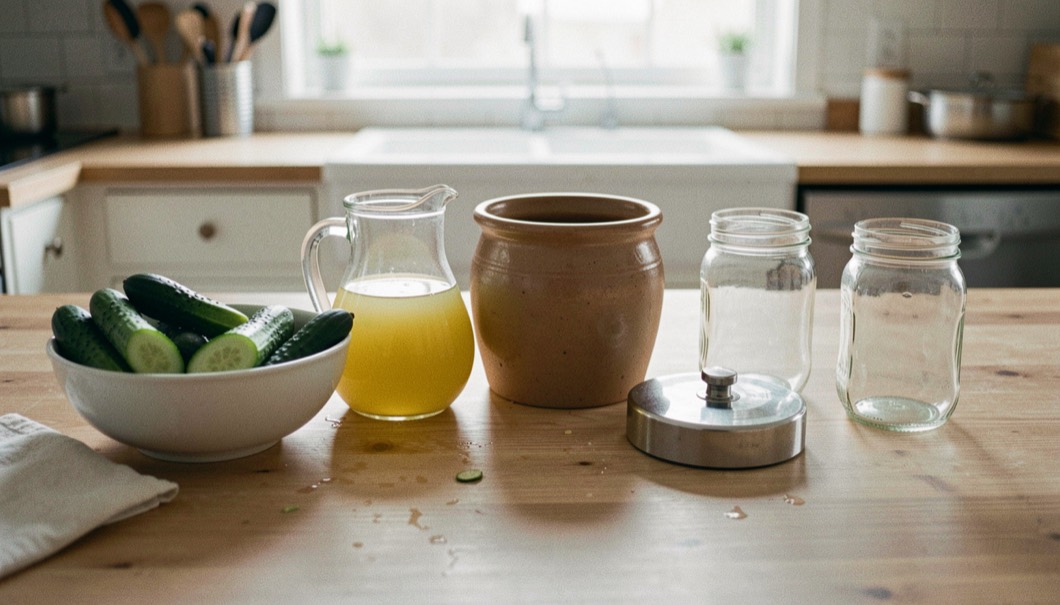
The container ratio is published: a 1-gallon container holds 5 pounds of fresh vegetables, and a 5-gallon jar suits about 25 pounds (NCHFP-Containers; PNW 355). Dill and spices go half at the bottom, half on top; the salt is dissolved in the vinegar and water and poured over (PNW 355).
The weight keeps vegetables 1 to 2 inches below the brine, with the container covered by a clean thick bath towel (NCHFP-Containers; PNW 355). The plate-and-jars method uses a plate slightly smaller than the opening, weighted with two or three sealed quart jars of water. The bag method uses a food-grade bag filled with brine, not plain water: "Using brine prevents dilution in case the bag leaks" (PNW 355). That brine is 1 1/2 tablespoons of salt per quart of water (PNW 355; NCHFP-Kraut; Penn State), and the large-bag version printed by the national guide for the container itself is 4 1/2 tablespoons of salt in 3 quarts of water (NCHFP-Containers).
Holding the temperature, which sets the clock
Temperature is the number that decides how long everything takes. For cucumbers: 70 to 75 degrees F means 3 to 4 weeks; 55 to 65 degrees F means 5 to 6 weeks; above 80 degrees F, "pickles will become too soft" (NCHFP-Dill; PNW 355; Clemson; Penn State). For sauerkraut, the national guide, PNW 355 and Penn State publish 70 to 75 degrees F for 3 to 4 weeks, and warn that below 60 degrees F "kraut may not ferment" while above 75 degrees F "kraut may become soft." Colorado State publishes 68 to 72 degrees F for only 7 to 14 days (CSU-Sauerkraut). These two published sets do not agree; both are given here as printed.
| Jar size | 0 to 1,000 ft | 1,001 to 6,000 ft | Above 6,000 ft |
|---|---|---|---|
| Pint | 10 min | 15 min | 20 min |
| Quart | 15 min | 20 min | 25 min |
Watching the surface and deciding it is finished
The published monitoring instruction is to check "several times a week" and remove surface scum or mold immediately (NCHFP-Dill; PNW 355). The signs of failure are published too: discard any batch that is soft, slimy, or has a foul odor (NCHFP-Dill). High fermentation temperature is itself listed among published causes of soft or slimy pickles (NCHFP-Problems). No accepted source publishes a pH target or an acidification curve for the home fermenter: not found. Done means the published time has elapsed at the published temperature, nothing else measurable at home.
The one rule to carry into the kitchen
Do not alter the published proportions of salt, vinegar, food, or water in any recipe, and do not use vinegar of unknown acidity (NCHFP-Pickle-Gen; PNW 355; Penn State; Clemson). There must be "a minimum, uniform level of acid throughout the mixed product to prevent the growth of botulinum bacteria" (NCHFP-Pickle-Gen). If the result is too sour or too salty, the published adjustment is a small amount of sugar, never less vinegar or more water (PNW 355).
Storing in place or canning in jars
Two options are published. Storage in the original container keeps 4 to 6 months under refrigeration, with scum and mold removed regularly (NCHFP-Dill; PNW 355; Clemson). Canning, printed as the better method by PNW 355, means bringing the brine to a boil, simmering 5 minutes, filling hot pint or quart jars to 1/2 inch of headspace, and processing per the table above. A low-temperature alternative, 180 to 185 degrees F for 30 minutes, carries the printed caution "Use only when recipe indicates" (NCHFP-LowTemp; PNW 355).
What this page does not say: it gives no brine percentage for any vegetable except cabbage, where only Colorado State publishes one, and none at all for cucumbers. It does not cover fresh-pack or quick-process pickles beyond the vinegar rule, and it does not reprint the FDA microbiological growth limits for pathogens, because those figures describe fishery products, not a home vegetable recipe, and are not cooking instructions.
Sources of the figures on this page
- National Center for Home Food Preservation, University of Georgia, General Information on Pickling, adapted from the USDA Complete Guide to Home Canning, revised 2015, reviewed February 2018. The four classes of pickled product, the 5 percent vinegar requirement, and the prohibition on altering proportions.
- National Center for Home Food Preservation, University of Georgia, General Information on Fermenting, adapted from the USDA Complete Guide to Home Canning, AIB 539, revised 2015. What the salt does in a ferment, and the prohibition on reducing it.
- Oregon State University Extension Service, Pickling Vegetables, PNW 355, by Jeanne Brandt, revised July 2019, reviewed 2024. Equipment, water, salt and vinegar, the fermentation procedures and seventeen tested recipes.
- National Center for Home Food Preservation, University of Georgia, Dill Pickles, in the fermenting recipes, adapted from the USDA Complete Guide to Home Canning, AIB 539, revised 2015. Quantities, container, weight, fermentation temperature and duration, storage and the boiling water schedule for fermented cucumbers.
- National Center for Home Food Preservation, University of Georgia, Suitable Containers, Covers and Weights for Fermenting Food, extracted from the USDA Complete Guide to Home Canning, AIB 539, revised 2009. One gallon of capacity per five pounds of vegetable, the plate and jar weight, the brine filled bag, and one to two inches under the brine.