Vegetable by vegetable
Four vegetables this manual gives no recipe for, and why
The page that exists because the honest answer to a question is sometimes that nobody tested it, and a manual on this subject may not guess.
On this page
On this page
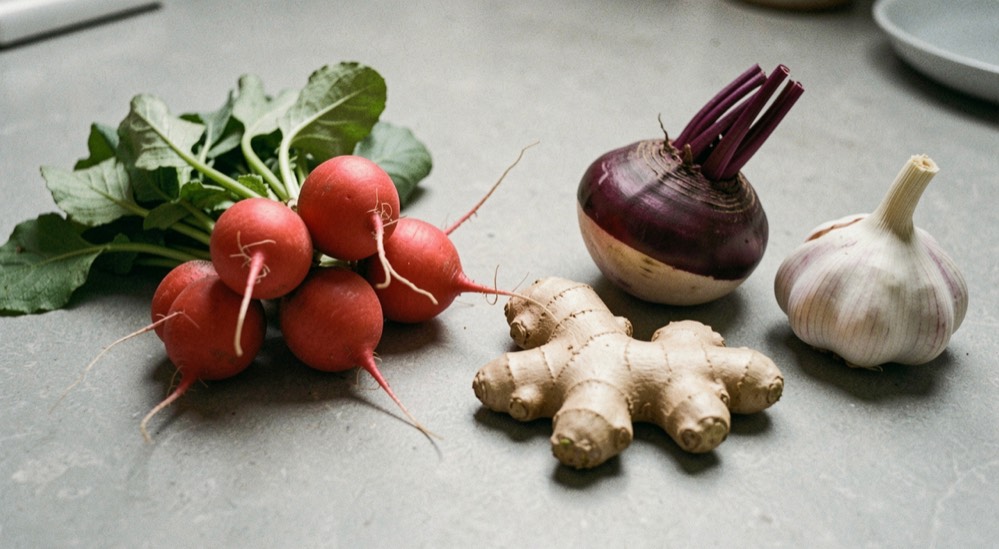
Most of this manual passes on what published, tested instructions say. This page does the opposite: it records four vegetables for which the sources consulted publish no brine-fermentation or pickling recipe at all. Radish, turnip, ginger, and garlic as a subject in its own right are absent from every accepted source that could actually be reached during this pass. That absence is stated here as a finding, not as a claim that no such recipe exists anywhere.
What was searched, and where
The search was exhaustive within the sources actually consulted. The full text of the national guide, USDA's Guide 6: Preparing and Canning Fermented Foods and Pickled Vegetables, was searched word by word for the terms "radish," "turnip," and "ginger." The complete recipe indexes of the National Center for Home Food Preservation at /how/pickle/, which enumerates more than seventy recipes, and /how/ferment/ were checked page by page. The Clemson HGIC search API was queried directly, twenty results at a time. The results are summarized below.
| Vegetable | Result |
|---|---|
| Radish | Not found. Guide 6 full text: no occurrence of "radish," only "horseradish," which is a different plant. NCHFP pickle and ferment indexes: nothing. Clemson search: no preservation recipe, only a horticultural sheet and daikon listed as a kimchi ingredient. |
| Turnip | Not found. Guide 6 full text: no occurrence of "turnip." Absent from both NCHFP indexes. |
| Ginger | Not found. Guide 6 full text: no occurrence of "ginger." Absent from both NCHFP indexes. Appears in the open corpus only as a minor ingredient: "1 tsp grated peeled fresh ginger" in Clemson's kimchi. |
| Garlic | No brining or fermentation recipe published. Appears only as an optional flavoring in fermented dill and kosher dill recipes, and as a hazard in oil. |
The access caveat, and what "not found" means
On the day of this pass, three accepted sources could not be queried at all. Oregon State's extension site returned a 403 on direct access, UMN Extension returned 403 systematically, and the Colorado State sheet 9.304 could not be located at its expected path. Oregon State's publication PNW 355 was nevertheless obtained through another channel. A statement of "not found" on this page therefore means "not found in the sources effectively consulted," not "nonexistent." The unpublished territory is smaller than it looks, and this manual cannot say by how much.
Two root-vegetable sheets exist but were not reviewed here
Two adjacent publications do exist and must be named honestly, because they are the most likely places a recipe could be hiding. The National Center publishes a pressure-canning sheet for roots, beets, carrots, turnips and rutabagas, but only in Spanish, titled "Raíces comestibles: remolachas, zanahorias, nabos y colinabos," and it is not a brining recipe; it was not reviewed. Penn State publishes "Let's Preserve: Root Vegetables - Beets, Carrots, Turnips and Rutabagas," which was likewise not reviewed here. Anyone considering turnips should verify those sheets directly before any use, and should not treat this page as a substitute for that verification.
An untested recipe is a safety question, not a matter of taste
This manual will not fill the gap by guessing. The vegetables listed above are excluded because no tested recipe exists in the consulted sources, and an invented brine strength or fermentation time is exactly the kind of untested instruction that food-safety publications exist to prevent. When the sources are silent, this manual is silent.
Why this manual does not improvise a recipe anyway
It would be easy to write a plausible radish or ginger recipe by analogy with cucumbers. Easy, and worthless as a safety document. In the USDA canon, the only published lactic fermentations are cucumbers, as fermented dill pickles, and cabbage, as sauerkraut; Clemson's kimchi sits outside that canon as an addition. Every other vegetable that readers ferment at home, green beans, carrots, beets, radishes, turnips, cauliflower, peppers, green tomatoes, onions, garlic, ginger, squash, does so without a published tested recipe behind it. A manual that guesses a salt concentration for an untested vegetable is not offering a flavor variation. It is publishing an unverified control of water activity, of salinity, and of the conditions under which unwanted organisms can grow. That is a safety question, and this manual does not answer safety questions by extrapolation.
Garlic on its own: a flavoring in the recipes, a hazard in oil
Garlic deserves separate treatment because the sources say two different things about it, and both matter. In fermented cucumber recipes, garlic appears only as an optional aromatic in fermented dill pickles and kosher dills. It is never the vegetable being brined. One quality point is published by Oregon State's PNW 355: "Garlic should be fresh and at the peak of maturity. Immature or sprouting garlic can turn blue in the jar." A second published point comes from the National Center's troubleshooting material: "Moldy garlic or spices" is listed as a cause of soft pickles. In oil, garlic is treated as a hazard, and the published terms are specific: an unacidified garlic or herb oil must be refrigerated and used within two or three days, an unacidified oil left more than two hours at room temperature must be discarded, and the published acidification is a 24 hour soak of the ingredients in a 3 percent citric acid solution (Clemson HGIC 3471).
What to do with this page
Use it as a map of the boundary, not as permission. If a reader wants fermented radish or turnip, the honest starting point is to check the two unreviewed root-vegetable sheets named above, and to treat any instruction found there, not any analogy, as the basis for the process. If nothing tested exists, the choice is to ferment without a tested recipe and own that choice, or to stick to the vegetables that have one. This manual records the boundary so that the choice is at least informed.
What this page does not say: it publishes no brine percentage, no fermentation time, no temperature, and no storage instruction for radish, turnip, ginger, or garlic, because none appears in the sources consulted. It does not report the harvest months for ginger distinguished from other roots, since no accepted source publishes them. It does not give the quantities in the National Center's no-sugar-added pickled beets recipe or in Penn State's root vegetable sheet, both unreviewed in this pass. And it does not rule on whether Oregon State, UMN Extension, or Colorado State publish recipes for these vegetables, because on the day of the search those services could not be reached at all.
Sources of the figures on this page
- United States Department of Agriculture, Complete Guide to Home Canning, Agriculture Information Bulletin 539, guide 6, Preparing and Canning Fermented and Pickled Foods, revised 2015. The canon these extension leaflets adapt, and by its silences, the vegetables for which nothing is published.
- National Center for Home Food Preservation, University of Georgia, General Information on Pickling, adapted from the USDA Complete Guide to Home Canning, revised 2015, reviewed February 2018. The four classes of pickled product, the 5 percent vinegar requirement, and the prohibition on altering proportions.
- Clemson Cooperative Extension, Home and Garden Information Center, Herb Infused Oils, HGIC 3471, originally published June 5, 2017. The conditions under which garlic in oil becomes a risk, and the published acidification and refrigeration limits.
- Penn State Extension, Botulism: A Deadly Concern, updated March 22, 2024. That the spores of Clostridium botulinum cannot grow in a high acid environment, and the requirement to follow a tested recipe.