Vegetable by vegetable
Sauerkraut, and the one recipe published as a percentage
The only vegetable on this site for which a source states the salt as a percentage of the weight, and the only one where two documents print different temperatures.
On this page
On this page
Sauerkraut is the one vegetable in this manual for which a source publishes the salt as a percentage of the cabbage's weight, rather than only as spoon-and-pound measures. That makes it a useful case study in how the same quantity can be expressed three ways, and how two documents can print different fermentation schedules without either one citing the other. Everything below is drawn from the national guide (NCHFP-Kraut), Oregon State's PNW 355, Clemson's HGIC 3380, Penn State (PSU-Ferment), and Colorado State (CSU-Sauerkraut).
Three published expressions of the same salt quantity
The full-batch recipe from the national guide and Clemson calls for 25 lbs of cabbage with 3/4 cup of canning or pickling salt, yielding approximately 9 quarts (NCHFP-Kraut; HGIC-3380). Oregon State's PNW 355 scales this to the container: 5 lbs of cabbage with 3 tbsp of salt, yielding 4 to 6 pints or 2 to 3 quarts. Penn State, for jar fermentation in small batches, prints 3 1/2 tbsp of salt per 5 lbs of cabbage (PSU-Ferment). Colorado State is the only source in this corpus that states the salt as a percentage: 2 to 2.5 percent of the weight of the cabbage (CSU-Sauerkraut). Work in roughly 5 lb batches regardless of the total quantity. Do not reduce the salt. The national guide states that you should not attempt to make sauerkraut or fermented pickles by cutting back on the salt required, and PNW 355 prints the caution: "Do not use reduced-sodium salt in brined pickles or sauerkraut."
Quality and preparation before the salt goes in
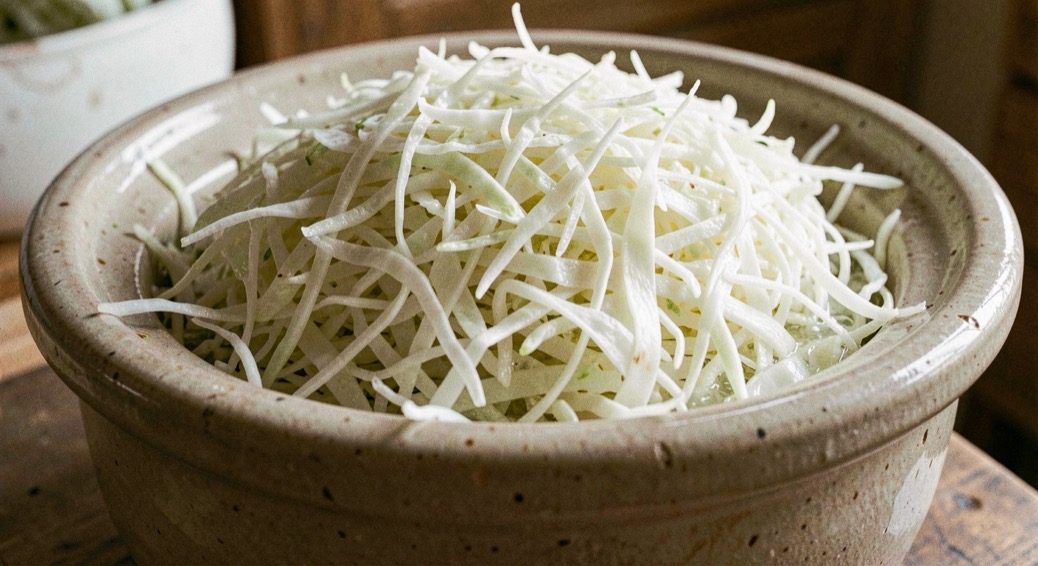
PNW 355 is explicit about raw material: "For the best sauerkraut, use firm heads of fresh cabbage. Start sauerkraut within 24 to 48 hours after harvest." Discard the outer leaves, rinse, drain, halve the heads and remove the cores, then shred to "the thickness of a quarter." Mix the salt in by hand until juice is drawn out and the salt is dissolved, then pack firmly (PNW 355). The sources do not explain why the 24 to 48 hour window matters, only that it is stated.
Container depth and the cover brine
The container must be deep enough that its rim sits at least 4 to 5 inches above the cabbage (NCHFP-Kraut; PNW 355). No accepted source states why this headroom is required; it is printed as an instruction. If the drawn-out juice does not cover the packed cabbage, add brine that has been boiled and cooled, at 1 1/2 tbsp of salt per quart of water (NCHFP-Kraut; PNW 355). Fermentation can be carried out in one-quart or half-gallon jars (PNW 355).
Two temperature windows that do not agree
This is the only vegetable page in this manual where the sources split. The national guide, PNW 355, Clemson, and Penn State all print the same schedule: store at 70°F to 75°F while fermenting, and sauerkraut will be fully fermented in three to four weeks; at 60°F, allow five to six weeks; below 60°F it may not ferment at all; above 75°F it may soften (NCHFP-Kraut; PNW 355; PSU-Ferment). The national guide also lists 60 to 65°F at five to six weeks (NCHFP-Kraut; PSU-Ferment).
Colorado State, in a sheet revised October 2025, prints 68-72°F for about 7 to 14 days (CSU-Sauerkraut). The CSU high range overlaps the zone the other sources place below their optimum, and its duration is two to four times shorter. Neither camp cites the other. This manual does not arbitrate between them: both schedules are published as printed, and you should know which document you are following before you set your fermentation spot.
Managing the ferment while it runs
If you weight the cabbage with a plate topped with jars, check the container two to three times per week and remove surface scum (PNW 355). If you weight it with a brine-filled bag, do not disturb the jar until fermentation is complete, signaled by the end of bubbling (PNW 355). Unprocessed finished kraut keeps "tightly covered in the refrigerator for several months," and it can also be frozen or canned (NCHFP-Kraut; PNW 355).
Boiling water bath processing, hot pack and raw pack
Process with 1/2 inch of headspace. Hot pack means bringing the sauerkraut and its juice to a boil before filling the jars (NCHFP-Kraut; PNW 355).
| Jar size | 0 to 1,000 ft | 1,001 to 3,000 ft | 3,001 to 6,000 ft | Over 6,000 ft |
|---|---|---|---|---|
| Pint | 10 min | 15 min | 15 min | 20 min |
| Quart | 15 min | 20 min | 20 min | 25 min |
PNW 355 prints the same values with the middle altitudes grouped: pints 15 min and quarts 20 min for 1,001 to 6,000 ft.
| Jar size | 0 to 1,000 ft | 1,001 to 3,000 ft | 3,001 to 6,000 ft | Over 6,000 ft |
|---|---|---|---|---|
| Pint | 20 min | 25 min | 30 min | 35 min |
| Quart | 25 min | 30 min | 35 min | 40 min |
Clemson confirms 20 minutes for pints and 25 minutes for quarts at low altitude (HGIC-3380).
Process raw pack quarts for 25 minutes at low altitude
The raw pack table in PNW 355 prints a low altitude figure for quarts that breaks the progression of its own row, which gives 30, 35, and 40 minutes at higher altitudes. Do not use that figure. The national guide and Clemson both print 25 minutes for a raw pack quart at 0 to 1,000 ft, and 25 minutes is the time to process (NCHFP-Kraut; HGIC-3380).
What this page does not settle
Nothing published here explains why the CSU fermentation window diverges from the others, and no source in this corpus arbitrates between 7 to 14 days at 68-72°F and three to four weeks at 70°F to 75°F. No source gives a percentage range for any vegetable other than cabbage, so no percentage is carried over to the other pages of this manual. The reason behind the 24 to 48 hour post-harvest window is likewise not stated in any of these documents.
Sources of the figures on this page
- National Center for Home Food Preservation, University of Georgia, Sauerkraut, adapted from the USDA Complete Guide to Home Canning, revised 2015. The 25 lb to three quarter cup ratio, the depth of the container, the fermentation temperatures and both processing schedules.
- Colorado State University Extension and FoodSmart Colorado, Understanding and Making Sauerkraut, reviewed October 2025. The only salt figure published as a percentage by weight, 2 to 2.5 percent, and a fermentation window of 68 to 72 F for 7 to 14 days.
- Oregon State University Extension Service, Pickling Vegetables, PNW 355, by Jeanne Brandt, revised July 2019, reviewed 2024. Equipment, water, salt and vinegar, the fermentation procedures and seventeen tested recipes.
- Penn State Extension, Let us Preserve: Fermentation, Sauerkraut and Pickles, updated May 22, 2023. Ratios, containers, temperatures, the prohibition on changing proportions, and the criteria for discarding a batch.
- Clemson Cooperative Extension, Home and Garden Information Center, Dill Pickles and Sauerkraut, HGIC 3380, revised February 5, 2002. A second published statement of the two fermented recipes and their low altitude schedules.