Vegetable by vegetable
Summer squash relish, the one recipe that is not a pickle
A relish rather than a pickle: the vegetable is grated, the liquid is thick with sugar, and the class it belongs to changes what the schedule is for.
On this page
On this page
- The recipe as printed, grated squash and no brine
- Why the grate matters, and the five-minute return to a boil
- Headspace and the requirement that the liquid covers the pieces
- The processing table for pints and half-pints
- Published substitutions, within this recipe only
- The other published squash entries, and how they differ
- Fermented zucchini does not exist in the published record
A relish and a pickle are both canned in vinegar, but they are not the same class of preparation, and the schedule for each follows from the class. In a pickle, the vegetable keeps its shape: slices, spears, whole fruit. In a relish, the vegetable is cut or shredded small, the liquid is thick with sugar, and the jar is packed with pieces rather than with identifiable vegetables. Summer squash relish, printed in Oregon State's PNW 355, is the one published squash recipe on the fresh-pack side that belongs to the relish class rather than the pickle class.
The recipe as printed, grated squash and no brine
Oregon State's PNW 355 prints the recipe under an attribution note: it was "Developed at The University of Georgia, Athens for the National Center for Home Food Preservation." The same recipe is published directly by the National Center for Home Food Preservation, released in April 2015. The two printings agree. The yield is about 5 pints, or 10 half-pints.
- 4 lbs of firm yellow summer squash and/or zucchini, with ½ cup of diced sweet onion.
- 2 cups of 5 percent cider vinegar, and 2¼ cups of white sugar.
- 2 tsp of celery seed, 2 tsp of turmeric, and 4 tsp of mustard seed.
There is no salt in this recipe and no water. The acidification comes from the cider vinegar alone, at 5 percent acidity, and nothing else. If you are used to pickle recipes that begin with a salt cover, notice that this one does not, and do not add one.
Why the grate matters, and the five-minute return to a boil
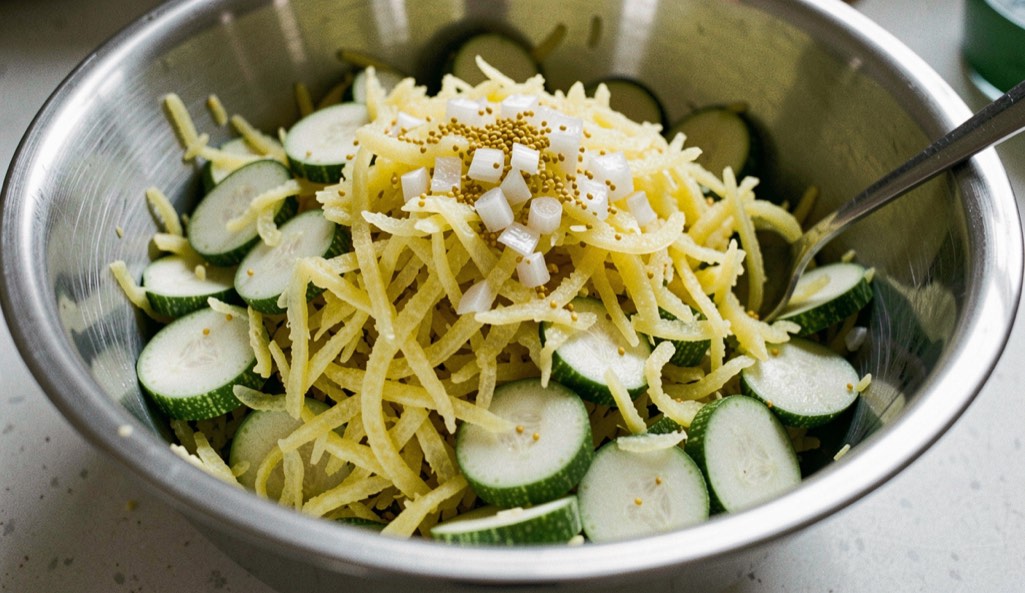
The published instruction reads: "Rinse squash well, remove blossom and stem ends and shred in a food processor." The grating is not a matter of convenience. A relish is defined by small pieces suspended in a sugared liquid, and a sliced squash would make a different product with a different packing behavior in the jar. The blossom and stem ends come off before the squash goes into the processor.
The vinegar, sugar, and three spices are brought to a boil first, the vegetables are added, and the mixture is boiled gently for 5 minutes, with the instruction to stir often. Oregon State's PNW 355 prints the same 5 minutes. This short cook is part of the recipe as tested; it is not a step you can extend or shorten on judgment.
Headspace and the requirement that the liquid covers the pieces
The headspace is ½ inch, printed by both Oregon State's PNW 355 and the National Center for Home Food Preservation. The National Center adds one sentence that carries the force of a rule: "Make sure liquid covers the top of the food pieces." A relish jar with exposed pieces at the top is a jar packed wrong, whatever the processing time. After processing and cooling, the published storage instruction is specific: "Refrigerate the canned relish once jars are opened for use."
The rule to carry out of this page
Half an inch of headspace, and every piece of grated squash under liquid before the lid goes on. The 5 percent cider vinegar is the only acid in the jar; the sugar thickens it but does not replace it.
The processing table for pints and half-pints
The relish is processed hot, in a boiling water bath, and the times vary only with altitude. Oregon State's PNW 355 prints the schedule.
| Jar size | 0 to 1,000 ft | 1,001 to 6,000 ft | Above 6,000 ft |
|---|---|---|---|
| Half-pint | 15 min | 20 min | 25 min |
| Pint | 15 min | 20 min | 25 min |
Published substitutions, within this recipe only
The published note allows the squash to be all yellow summer squash, all zucchini, or a mixture of the two, and allows celery salt to replace the celery seed. Both allowances are printed with the recipe in Oregon State's PNW 355. Nothing in the note extends to the vinegar, the sugar, or the spices beyond the celery substitution, and none of it transfers to any other recipe.
The other published squash entries, and how they differ
Three squash entries are published in total, and the other two are pickles, not a relish. The first is Pickled Bread-and-Butter Zucchini, printed in the USDA Complete Guide to Home Canning, Guide 6, page 6-26, revised 2015. It yields about 8 to 9 pints and uses 16 cups of sliced zucchini, 4 cups of finely sliced onions, ½ cup of canning or pickling salt, 4 cups of 5 percent white vinegar, 2 cups of sugar, and the same three spice families in different amounts. It begins with a salt cover that is discarded: "Cover zucchini and onion slices with 1 inch of water and salt. Let stand 2 hours and drain thoroughly." There is no water in its cover solution; the vinegar is boiled with sugar and spices, the vegetables are added, and the mixture simmers 5 minutes. Headspace is ½ inch, and processing is hot, 10, 15, or 20 minutes for pints or quarts by altitude, with an explicitly authorized alternative of low-temperature pasteurization, which the National Center for Home Food Preservation specifies as 30 minutes at 180 °F, the water never falling below 180 °F, with a thermometer required.
The second is the squash variation of the Bread-and-Butter Pickles, USDA Guide 6, page 6-9: "Variation: Squash bread-and-butter pickles. Substitute slender (1 to 1-1/2 inches in diameter) zucchini or yellow summer squash for cucumbers. Do not use the liming variation." The base recipe calls for cucumbers sliced 3/16 inch thick, covered with salt and 2 inches of crushed or cubed ice, and refrigerated 3 to 4 hours with more ice as needed. Its cover solution is boiled 10 minutes, headspace is ½ inch, and processing is hot, 10, 15, or 20 minutes. Guide 6 prints one numbered aging instruction with this recipe: "After processing and cooling, jars should be stored 4 to 5 weeks to develop ideal flavor." The prohibition on liming is stated in the variation itself and applies to it directly.
Notice the contrast with the relish: the two pickles salt first and slice, the relish grates and skips salt entirely. The classes are not interchangeable, and neither are their schedules.
Fermented zucchini does not exist in the published record
Every squash entry published is a fresh-pack vinegar recipe. No fermented zucchini or fermented summer squash recipe is published in any of the sources this manual draws on: nothing brined, nothing lacto-fermented, nothing cured in salt over time. The record reports this as not found, and this page does not fill the gap with an estimate. If you want a fermented summer vegetable, the published recipes use other vegetables, and a squash substitute would be an extrapolation no source here authorizes.
This page also does not give any pressure-processing alternative for the relish, any altitude table beyond the three bands printed above, or any sugar substitute. None is published with the recipe, and the two pickles printed alongside it follow their own schedules, which are not transferable to the relish.
Sources of the figures on this page
- Oregon State University Extension Service, Pickling Vegetables, PNW 355, by Jeanne Brandt, revised July 2019, reviewed 2024. Equipment, water, salt and vinegar, the fermentation procedures and seventeen tested recipes.
- National Center for Home Food Preservation, University of Georgia, General Information on Pickling, adapted from the USDA Complete Guide to Home Canning, revised 2015, reviewed February 2018. The four classes of pickled product, the 5 percent vinegar requirement, and the prohibition on altering proportions.