Vegetable by vegetable
Pickled asparagus, equal parts water and vinegar
One of the seventeen tested recipes in a single extension publication, and one of the few that names a twelve ounce jar in its schedule.
On this page
On this page
This recipe comes from Oregon State's PNW 355, one of the seventeen tested recipes gathered in that single extension publication. It is reprinted here as published, and it is one of the few recipes in the wider corpus that names a twelve ounce jar in its processing schedule, which is why it deserves its own page. Every figure below is quoted from that publication.
The full quantities before any jar is filled
The recipe as printed in Oregon State's PNW 355 starts with 8 pints of asparagus. The brine is built from equal parts water and vinegar: 6 cups of water plus 6 cups of 5 percent white vinegar. Alongside the liquid, the publication lists 6 tablespoons of salt, 2 teaspoons of pickling spice with the cloves removed, and 1 clove of garlic per jar. The headspace is given as one half inch.
Nothing in the source explains why the cloves are removed from the pickling spice, and no reason is offered for the one clove of garlic per jar rather than more or less. These are instructions, not explanations, and they should be followed as printed because this is a tested recipe.
Why the water to vinegar ratio is one to one
The equal parts ratio is the defining feature of this recipe. Six cups of water and six cups of 5 percent white vinegar, printed side by side in Oregon State's PNW 355, hold the acid at the level this tested recipe was written around; no accepted source states the resulting acidity as a percentage. The publication does not explain the reasoning behind this balance for asparagus specifically, so no reason is offered here. What can be said is that the ratio is fixed: the recipe does not invite adjustment, and a tested schedule assumes the acid level that this one to one mixture produces.
The one to one rule
Six cups of water and six cups of 5 percent white vinegar, exactly as printed in Oregon State's PNW 355. Do not weaken or strengthen this ratio, because the processing times are tested against it.
Salt, spice, and garlic per batch
The salt is measured for the whole batch, not per jar: 6 tablespoons for 8 pints of asparagus, according to Oregon State's PNW 355. The garlic, by contrast, is measured per jar: 1 clove goes into each container. The pickling spice is 2 teaspoons total, with the cloves removed before use.
- 6 tablespoons of salt for the batch, Oregon State's PNW 355.
- 2 teaspoons of pickling spice, cloves removed, for the batch.
- 1 clove of garlic per jar.
- One half inch of headspace in every jar.
The processing schedule that names a twelve ounce jar
The processing times are what set this recipe apart in the corpus. Oregon State's PNW 355 gives a schedule that names three jar sizes: the pint, the twelve ounce jar, and a third size covered in the table below. The times run 10, 15, and 20 minutes according to altitude. This is one of the few tested recipes anywhere in this collection that acknowledges the twelve ounce jar at all, which makes the schedule unusually precise for a household batch.
| Jar size | Time by altitude tier |
|---|---|
| Pint | 10 / 15 / 20 minutes |
| Twelve ounce jar | 10 / 15 / 20 minutes |
The source presents the three tiers as a single row of figures, 10, 15, and 20 minutes, tied to altitude in the usual way that extension schedules are tied to altitude. The publication does not spell out on this page which altitude boundary separates each tier, so that boundary is not restated here. Follow the altitude instructions given in the publication itself when you set your timer.
Where this recipe sits among the seventeen
Oregon State's PNW 355 collected seventeen tested recipes in one extension publication, and this asparagus recipe is one of them. That origin matters for how the page should be read. Each of the seventeen was tested as printed, with its own brine ratio, its own spice list, and its own processing schedule. The asparagus recipe is not a template to be borrowed for other vegetables, and its one to one water and vinegar ratio is not a general rule. It is the ratio tested for asparagus in that publication, nothing more.
What to keep straight when you pack the jars
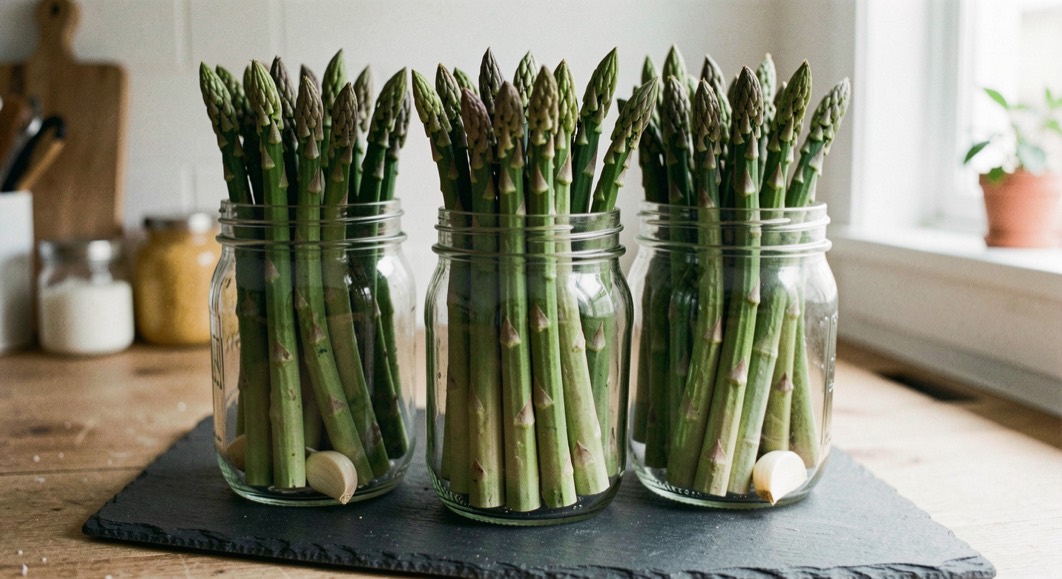
Trim the asparagus to fit the jar size you are using, keep the one half inch headspace that Oregon State's PNW 355 specifies, and put one clove of garlic in each jar before the brine goes in. The brine itself is the six cups of water, six cups of 5 percent white vinegar, and 6 tablespoons of salt, brought together as the publication directs. The pickling spice, 2 teaspoons with cloves removed, seasons the batch. These quantities are sized for 8 pints of raw asparagus, so scale your preparation around that amount rather than around the jars you happen to have.
What this page does not say: the source material does not state the altitude boundaries that separate the 10, 15, and 20 minute tiers, does not name the third jar size beyond the pint and the twelve ounce jar in a form this page can quote with confidence, and publishes no storage life, no shelf stability duration, and no cooling or resting instruction for this recipe. Nothing beyond the quantities, the headspace, and the processing times printed above appears in the matter available for this page, and no figure has been added from any other publication.
Sources of the figures on this page
- Oregon State University Extension Service, Pickling Vegetables, PNW 355, by Jeanne Brandt, revised July 2019, reviewed 2024. Equipment, water, salt and vinegar, the fermentation procedures and seventeen tested recipes.