Vegetable by vegetable
Cauliflower and Brussels sprouts, and a salt that is thrown away
One of the two recipes here with a salted blanching water, a quantity that never reaches the jar and must not be confused with a brine.
On this page
On this page
Both vegetables on this page travel through the same recipe, the one printed by the National Center for Home Food Preservation as "Pickled Cauliflower or Brussels Sprouts" in Guide 6, page 6-17, and carried by the USDA Complete Guide to Home Canning, revised 2015. Clemson's HGIC 3400, revised February 5, 2001, prints the same recipe. It is a pickled product, not a fermented one, and the salt in it behaves in a way that surprises many readers: it is measured, used once, and poured down the drain.
A salted blanching water that never becomes a brine
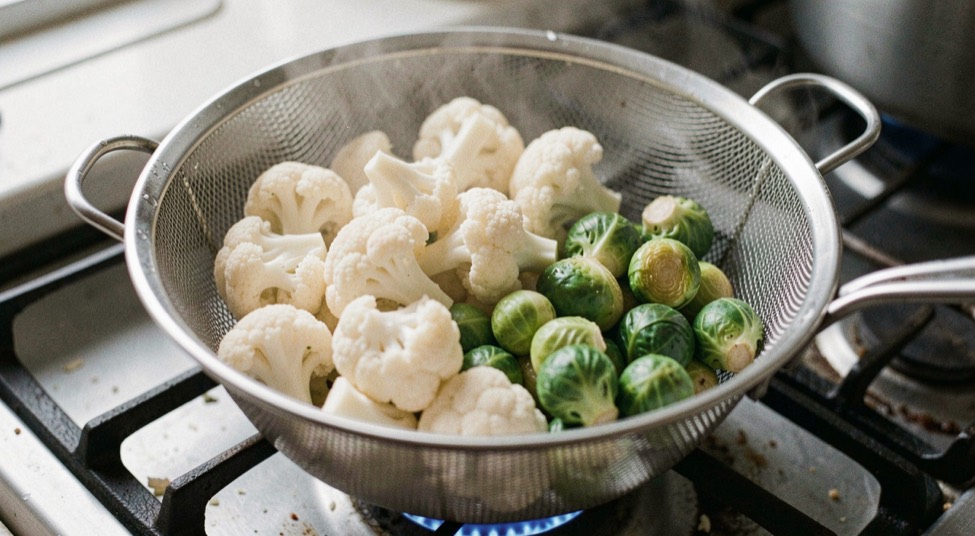
The single most important point on this page concerns the salt water in which the vegetables are blanched. The NCHFP directs you to "boil in salt water (4 tsp canning salt per gallon of water) for 3 minutes for cauliflower and 4 minutes for Brussels sprouts. Drain and cool." That is the full life of this salt. The blanching water is discarded after the drain, and none of it goes into the jars.
Do not confuse this with a brine. A brine is a salt solution that surrounds the food in the jar and takes part in the preservation. Here, the covering solution contains no water and no salt at all. The salt exists only in the blanching pot, and no accepted source states what it does there; it is drained away with the water. If you counted that 4 tsp per gallon toward any jar calculation, you would be counting salt that is already gone.
The salt is thrown away
The 4 tsp of canning salt per gallon of water is measured into the blanching pot only. After 3 minutes for cauliflower or 4 minutes for Brussels sprouts, the water is drained and discarded. It never reaches the jar, and it is not a brine.
The full quantities, as the National Center prints them
The recipe yields about 9 half-pints. The ingredient list from the NCHFP, in the order the guide prints it:
- 12 cups of cauliflower flowerets, 1 to 2 inches across, or small Brussels sprouts
- 4 cups of white vinegar at 5 percent acidity
- 2 cups of sugar
- 2 cups of thinly sliced onions
- 1 cup of diced sweet red pepper
- 2 tbsp of mustard seed
- 1 tbsp of celery seed
- 1 tsp of ground turmeric
- 1 tsp of red pepper flakes
Read the covering solution carefully: it is pure 5 percent vinegar and sugar, with no added water. There is no salt anywhere in the jar. The only sodium in this recipe lives in the blanching water and leaves the kitchen through the drain.
Why white vinegar, and what the guide says about color
The choice of vinegar is not arbitrary in this recipe. The NCHFP notes: "White vinegar is usually preferred when light color is desirable, as is the case with fruits and cauliflower." The pale curds of cauliflower are exactly the case the guide has in mind. A darker vinegar would darken the finished pieces, and the guide tells you so in its own words.
Headspace and the processing schedule
The NCHFP specifies a headspace of one half inch. This is a hot pack recipe, filled into half-pint or pint jars, and processed in a boiling water bath. The processing times printed by the NCHFP, which depend on altitude, are 10, 15, or 20 minutes. Clemson's HGIC 3400 prints the same recipe with a 10 minute boiling water bath time, which corresponds to the lowest altitude band of the national schedule.
| Pack | Jar sizes | Processing times |
|---|---|---|
| Hot pack | Half-pints or pints | 10, 15, or 20 minutes in a boiling water bath, by altitude |
Where cauliflower also appears, and where it does not
Beside this recipe, the NCHFP index also lists cauliflower among the vegetables in its Pickled Mixed Vegetables recipe. That is the extent of what the national guide publishes for this vegetable in a pickled form. Both appearances are vinegar pickles processed in a boiling water bath.
Fermented cauliflower: nothing is published
This page sits in a manual about brining and fermentation, so the question must be asked plainly: no fermented cauliflower recipe is found in the published material this page draws on. Not a slow one, not a quick one, not a ratio, not a time, not a temperature. Nothing is published, and this manual will not invent a number where the sources print none. If you hold a jar of cauliflower under a salt brine on your counter, you are working outside anything the national guide or Clemson has printed, and you are doing so without published processing instructions behind you.
What this page does not say: it gives no fermentation schedule for cauliflower or Brussels sprouts, because no source here publishes one. It does not extend the blanching salt of 4 tsp per gallon to any other vegetable, and it does not treat the pickling solution as a brine for reuse. The mixed vegetables recipe mentioned above is named but not detailed here, and its own quantities and processing times belong to the page that covers it.
Sources of the figures on this page
- National Center for Home Food Preservation, University of Georgia, Pickled Cauliflower or Brussels Sprouts, adapted from the USDA Complete Guide to Home Canning, guide 6, revised 2015. The blanching salt at four teaspoons per gallon, the three and four minute blanch, and the pint schedule.
- United States Department of Agriculture, Complete Guide to Home Canning, Agriculture Information Bulletin 539, guide 6, Preparing and Canning Fermented and Pickled Foods, revised 2015. The canon these extension leaflets adapt, and by its silences, the vegetables for which nothing is published.
- National Center for Home Food Preservation, University of Georgia, General Information on Pickling, adapted from the USDA Complete Guide to Home Canning, revised 2015, reviewed February 2018. The four classes of pickled product, the 5 percent vinegar requirement, and the prohibition on altering proportions.