Vegetable by vegetable
Kimchi, the one ferment here that is never made shelf stable
One source in this whole set publishes a kimchi procedure, and it differs from every other page here in the way that matters most: the jar never becomes shelf stable.
On this page
On this page
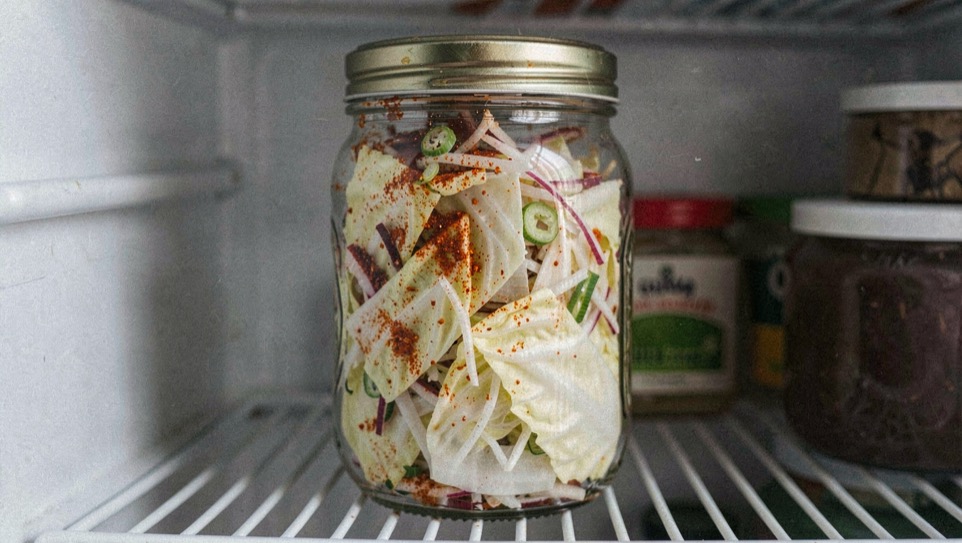
One source in this manual's entire set publishes a kimchi procedure: Clemson's Home & Garden Information Center, in a fact sheet titled "Kimchi Basics and How to Make Homemade Kimchi" and dated September 4, 2025. Every other fermented vegetable covered on these pages ends in a jar that can sit on a shelf. This one does not. The Clemson kimchi is a refrigerated lactic fermentation with no published heat treatment, and Clemson publishes no step that would make it shelf stable. That single fact shapes everything else on this page.
The jar never becomes shelf stable
Clemson's procedure includes no boiling water bath, no jar size, and no altitude adjustment. Those three absences are not oversights. They follow from the nature of the product: nothing in the published procedure raises the jar to a temperature or holds it for a time that would make it safe at room temperature. Clemson stores the finished kimchi in the refrigerator for up to 6 months, and that is the whole of its storage guidance. A reader who cans this kimchi in a boiling water bath is following a procedure that no source here publishes.
Never store this kimchi at room temperature
Clemson, the only source here that publishes a kimchi recipe, ferments it and refrigerates it. No published step makes the jar shelf stable, and no other source in this set provides one.
The salting step is rinsed away, so it is not the finished salinity
The recipe salts the cabbage first, then rinses most of that salt off before fermentation. Clemson calls for ¼ cup of non iodized sea salt or kosher salt for about 2 lbs of napa cabbage, massaged onto the cabbage, covered with water, and weighted with a plate. The instruction reads: "Let stand for 1-2 hours." After that, the cabbage is rinsed 2 to 3 times and drained for 15 to 20 minutes.
Because the brining salt is largely rinsed out, it cannot be read as the salt concentration of the finished ferment. A reader comparing this recipe against the sauerkraut figures would be comparing unlike things. The only published percentage in this manual is 2 to 2.5 percent of the weight of the cabbage, from Colorado State, and no accepted source publishes any brine percentage for fermented cucumbers at all. Clemson does not publish a finished salinity figure, and none appears anywhere in this set.
What Clemson's ingredient list contains
The published recipe gives full quantities for a single batch:
- 1 medium head napa cabbage (about 2 lbs)
- ¼ cup non iodized sea salt or kosher salt, for the pre rinse
- Water, for covering during the salting step
- 1 tbsp grated garlic (5 to 6 cloves)
- 1 tsp peeled and grated fresh ginger
- 1 tsp sugar
- 2 tbsp fish sauce
- 1 to 5 tbsp Korean chili flakes (gochugaru)
- 8 oz Korean radish or daikon, cut into sticks
- 4 medium green onions, cut into 1 inch pieces
The gochugaru range, 1 to 5 tbsp, is the only quantity in the list Clemson leaves to the reader's taste. Clemson does not explain why the garlic must be grated rather than sliced, and this page will not guess.
Where and how long to ferment it
Clemson's fermentation instruction is quoted in full: "Let the kimchi ferment by leaving it at room temperature (68 °F-72 °F), out of direct sunlight for 1 to 5 days, or in the refrigerator for longer ferment time." Two paths are therefore published: a warm counter fermentation lasting 1 to 5 days, or a slower fermentation in the refrigerator, for which Clemson gives no end date. When the flavor suits you, Clemson says: "When the kimchi tastes to your liking, transfer it to the refrigerator for storage for up to 6 months."
The 1 to 5 day window is wide, and Clemson does not narrow it by taste markers or by bubble activity. The reader's palate is the published test of doneness. The exclusion of direct sunlight is stated but not explained by Clemson, and no source in this set explains it for kimchi specifically.
The word kimchi is absent from the national guide
The National Center for Home Food Preservation publishes no kimchi recipe. The word appears nowhere in the full text of the USDA complete guide's fermenting volume, and the index of its pickle and ferment sections lists neither kimchi nor the radish, turnip, ginger, or garlic that go into it. This was checked against the full text. The practical consequence is plain: a reader looking for a federal or national center version of this recipe will not find one, and any kimchi procedure in this manual must be attributed to Clemson by name.
Two university extensions disagree, and this page does not settle it
Penn State, in its fermented vegetables guidance updated May 22, 2023, writes that "only research-based recipes for fermented vegetables include procedures for sauerkraut and fermented pickles." Clemson publishes a full kimchi procedure. Both are university extension publications, neither cites the other, and the two positions do not agree on whether a kimchi recipe of this kind exists among research based procedures. This page reports the tension without resolving it. A writer or teacher who uses the Clemson recipe should name its source and state that it has no USDA equivalent.
What this page does not say: no source here publishes a finished salt concentration for kimchi, a maximum refrigerator fermentation time before the taste test, a yield in finished jars, or any heat treatment of any kind. Nothing here transfers to fermenting radish, turnip, or ginger on their own, for which no procedure is published in this set. The tension between Clemson and Penn State is reported above and remains unresolved in print.
Sources of the figures on this page
- Clemson Cooperative Extension, Home and Garden Information Center, Kimchi Basics and How to Make Homemade Kimchi, September 4, 2025. The only kimchi procedure published inside this set of sources: a refrigerated lactic fermentation with no heat process of any kind.
- United States Department of Agriculture, Complete Guide to Home Canning, Agriculture Information Bulletin 539, guide 6, Preparing and Canning Fermented and Pickled Foods, revised 2015. The canon these extension leaflets adapt, and by its silences, the vegetables for which nothing is published.
- Penn State Extension, Let us Preserve: Fermentation, Sauerkraut and Pickles, updated May 22, 2023. Ratios, containers, temperatures, the prohibition on changing proportions, and the criteria for discarding a batch.